Every support team knows the shape of the problem. A large fraction of tickets are variations on questions that have already been answered somewhere. The answer exists; finding it fast enough, in the customer's words, is the bottleneck. An AI-powered knowledge base attacks exactly that gap.
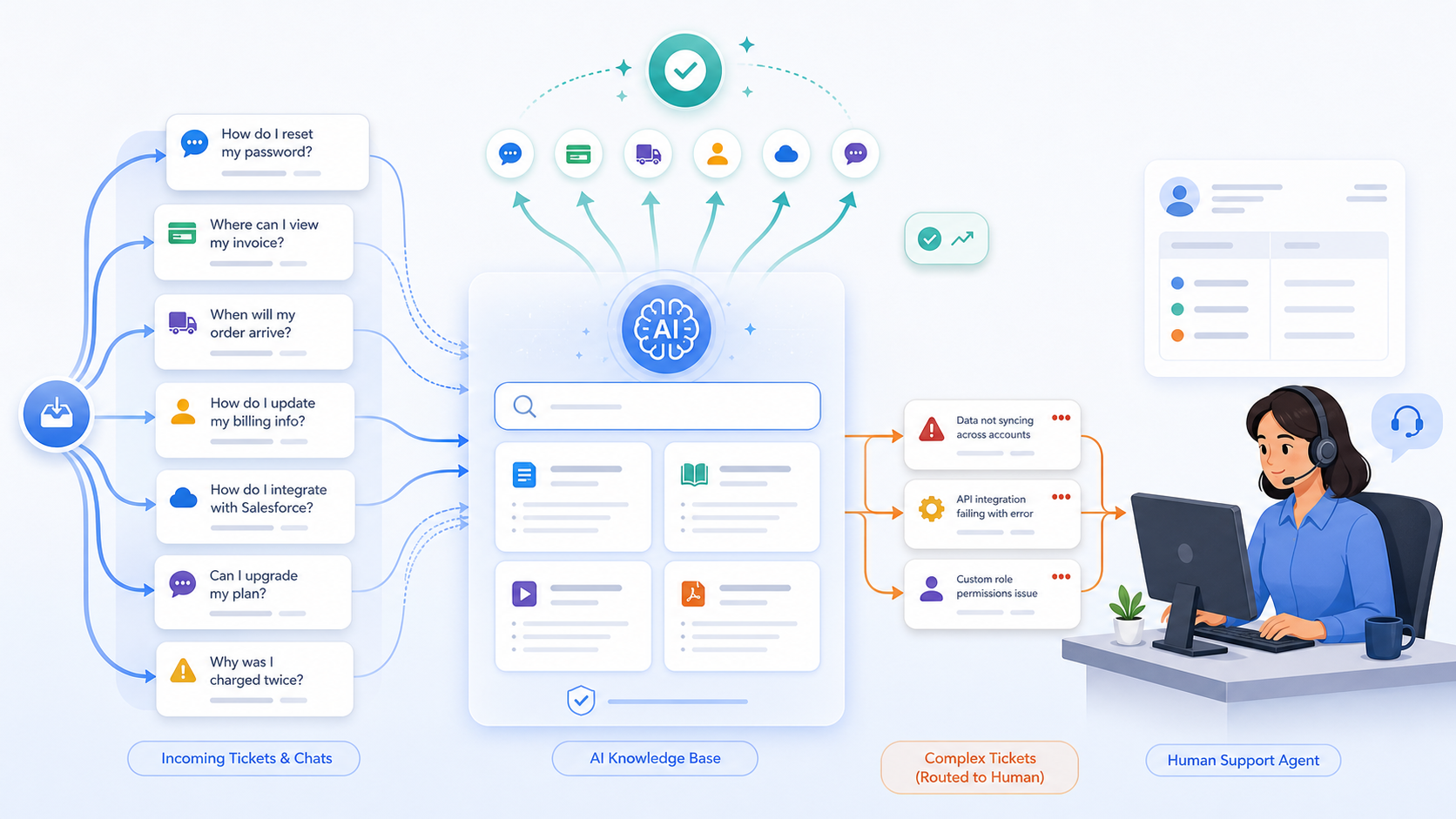
Where the time actually goes
Break down a typical support interaction and the delays cluster in predictable places:
- The customer can't find the answer themselves, so they open a ticket for something that's documented.
- The agent has to locate the answer, digging through help docs, past tickets, and internal wikis that don't share a search box.
- The answer is scattered, so the agent assembles it from three sources before replying.
Notice that none of these is about the agent's skill or effort. They're all retrieval problems: the knowledge exists but isn't reachable quickly in the form the moment demands. That's the leverage point.
Two workflows, one knowledge base
A good AI knowledge base improves support from both ends, using the same underlying content.
Self-service (deflection). An answer widget or chatbot sits in your help centre and product. When a customer asks a question in their own words, semantic search finds the relevant passage even if it shares no keywords with the docs, and an LLM composes a grounded answer with a link to the source. Questions that are genuinely documented get resolved without ever becoming a ticket. This is ticket deflection, and it's where the headline time savings come from. The fastest first response is the ticket that never gets created.
Agent-assist. For the tickets that do come through, the same knowledge base works behind the agent. Instead of hunting across systems, the agent gets suggested answers with sources attached; they review, adjust tone, and send. First response time drops because the "find the answer" step is now instant, and answers stay consistent because everyone draws from the same source of truth.
Why semantic search is the unlock
Traditional help-centre search matches keywords, so it fails exactly when customers need it most, because customers don't use your vocabulary. They type "money back," your doc says "refund." They type "app won't open," your doc says "application launch failure." Keyword search returns nothing; the customer gives up and files a ticket.
Semantic search compares meaning, not spelling, so "money back" finds the refund policy and "app won't open" finds the launch troubleshooting guide. Pair it with keyword search in a hybrid approach, so exact things like error codes and product names still match precisely, and you cover both the vague and the specific. This is the single biggest reason AI knowledge bases deflect tickets that old FAQ search couldn't.
Source attribution isn't optional
There's a right way and a wrong way to deploy this. The wrong way is a chatbot that generates confident answers from nowhere; one hallucinated refund policy and trust is gone. The right way grounds every answer in your actual content and shows the source.
Source links do three things at once: they let the customer verify the answer (which builds trust), they give the agent something to stand behind, and they make wrong answers debuggable: if the AI cited the wrong doc, you can see exactly why and fix the content. An AI support answer without a citation is a liability. With one, it's a faster, verifiable version of what a great agent would have said.
Keeping it accurate over time
The failure mode of any support knowledge base is staleness: a policy changes, the docs don't, and the AI confidently repeats the old answer to everyone. Two habits prevent it:
- Sync from the source. Connect the knowledge base to where your docs actually live so updates flow through automatically instead of depending on someone remembering to re-upload.
- Mine failed answers. Log the questions where the AI found nothing or the customer still filed a ticket. That list is your content backlog. It tells you exactly which gaps to write next.
Done consistently, this creates a compounding loop: every unanswered question becomes new content, which deflects the next batch of similar tickets.
What good looks like
A support org running this well ends up with:
- A shrinking share of tickets for documented questions (deflection climbing over time).
- Faster first response on the tickets that remain, because agents stop hunting for answers.
- More consistent answers, since humans and AI draw from one source of truth.
- A tight feedback loop turning support gaps into knowledge-base content.
The goal was never to replace agents. It's to stop making them, and customers, hunt for answers that already exist. Get the knowledge base right, make it semantically searchable, ground every answer in a citable source, and keep it fresh. The response-time gains follow from that, not from the model doing anything clever.